
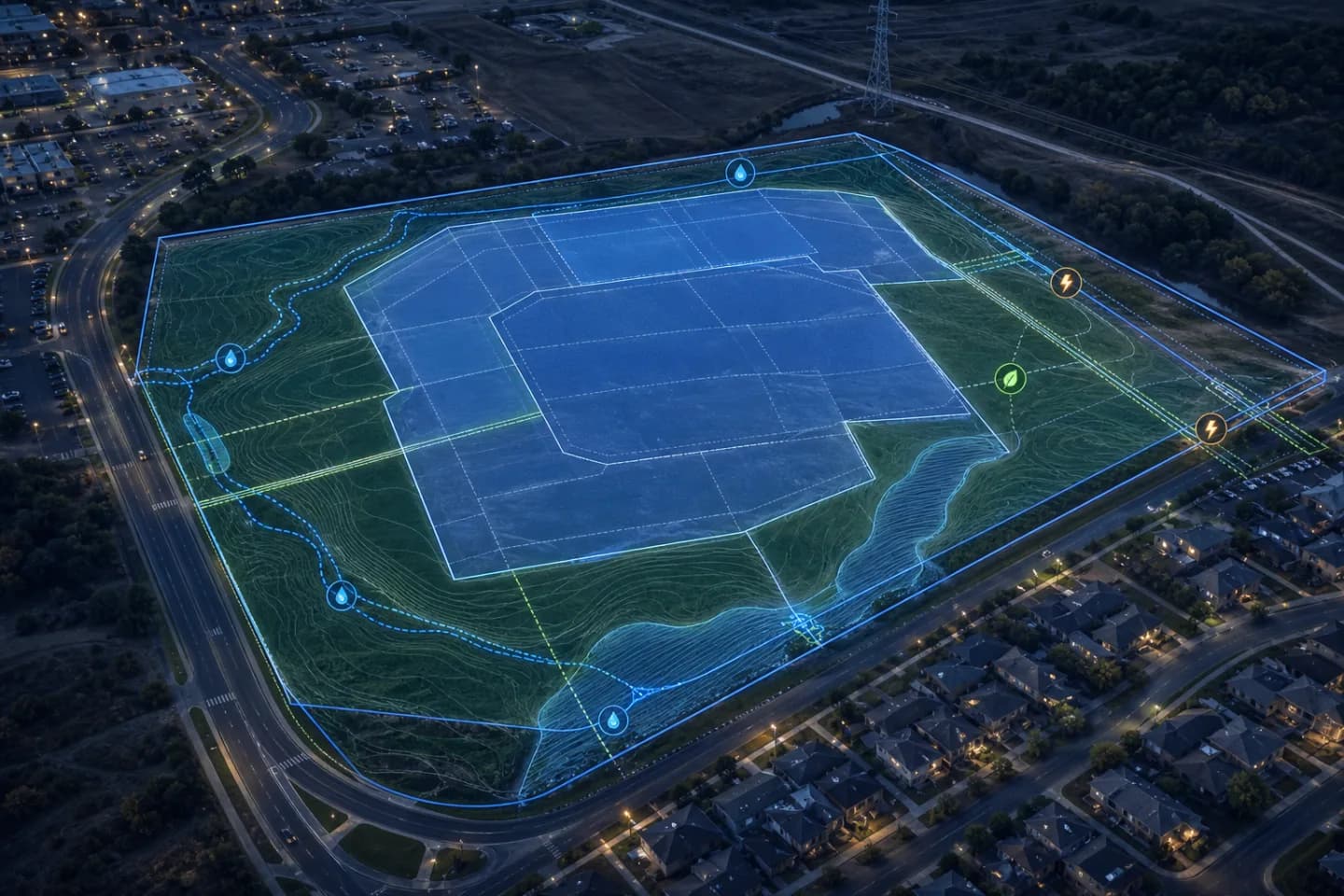
Feasibility has always required judgment. The change is that AI-assisted workflows can now assemble and cross-check more of the evidence behind that judgment before a team commits significant time and capital.
From document search to decision support
Traditional feasibility work often begins with a hunt across GIS portals, ordinances, utility records, reports, and consultant files. AI is most useful when it helps structure those sources into a project-specific record—not when it produces a context-free answer.
Where AI creates practical value
The strongest workflows connect source material to the question a development team is actually asking: what can be built, what could prevent it, and what requires verification?
- Extracting dimensional and use requirements
- Relating site constraints to a buildable envelope
- Tracking infrastructure and environmental unknowns
- Comparing sites with consistent criteria
Professional judgment remains essential
AI-generated findings should be traceable and reviewable. Survey, engineering, legal, environmental, and jurisdictional confirmation still matter; the opportunity is to focus that expertise sooner on the issues most likely to change the project.